
Who must file, how each asset is valued, when a further return becomes due, and what information is worth gathering before the year ends — because some figures can only be obtained on 31 December.
Every spring we have the same conversation with clients who want to comply and cannot, because one figure is missing and is no longer available anywhere. It is not a problem of legislation but of timing. This guide sets out the obligation in full and, above all, what is worth doing now.
1. What they are, and what they are not
Form 720 is an information return. No tax is assessed and nothing is paid with it: its purpose is to tell the Spanish Tax Agency what assets and rights are held outside Spain. Form 721 performs the same function in respect of virtual currencies held abroad.
The obligation applies only to Spanish tax residents. Anyone taxed in Spain as a non-resident, under the Non-Resident Income Tax, falls outside its scope.
2. The three obligations within Form 720
Although filed on a single form, Form 720 contains three independent information obligations, each with its own €50,000 threshold:
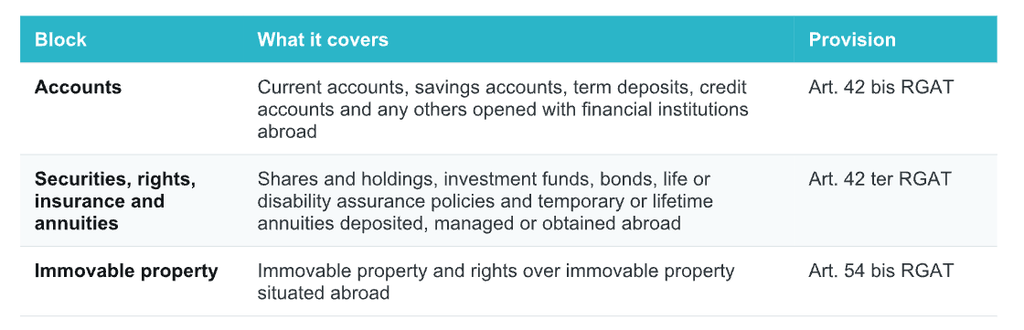
The three blocks are not added together. One may hold €40,000 in accounts, €45,000 in securities and a €200,000 flat, and be obliged to file in respect of the property block alone.
And a point frequently overlooked: once a block exceeds €50,000, every item within that block must be reported, not merely those above the threshold. Once the limit is crossed on accounts, the account holding €300 that was opened years ago and never closed comes in as well.
3. Form 721: virtual currencies
Approved by Order HFP/886/2023 of 26 July, Form 721 requires the reporting of virtual currencies held abroad where the aggregate balance at 31 December exceeds €50,000. For each type of currency, the units held and their valuation in euros are reported, together with the identification of the entity safeguarding the private cryptographic keys.
Valuation follows the price at 31 December quoted by the principal trading platforms or price-tracking websites, or a reasonable estimate of market value, always stating the source used.
4. Who must file
The obligation is not confined to the formal owner. It extends to representatives, authorised persons, beneficiaries, persons with powers of disposal and beneficial owners. It is common to find that someone must file in respect of an account on which they appear only as an authorised signatory — a relative’s foreign account, or a company’s — without owning a single euro of it.
Joint ownership
Where ownership is shared, the full balance or value is reported, without apportionment, stating the percentage of participation. The €50,000 threshold is likewise measured against the total value of the asset, irrespective of the number of owners. An account of €150,000 held equally by two people obliges both, and each reports the full €150,000 alongside their percentage.
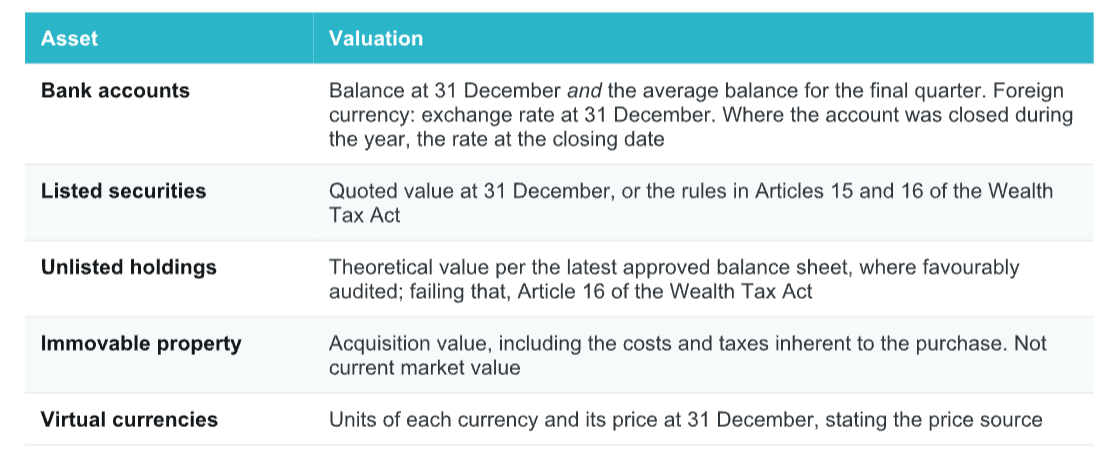
5. How each asset is valued
6. If you have filed Form 720 in previous years
It need not be repeated every year. The obligation revives in two situations:
- Where the aggregate value of a block has increased by more than €20,000 over the figure that gave rise to the last return filed.
- Where ownership has ceased: an account closed, securities sold, a property transferred. A return is then due even if the €20,000 increase has not been reached.
It is worth bearing in mind that exchange-rate movements count towards that increase, save in the property block. A portfolio held in sterling or dollars may cross the threshold without its owner having moved a single asset.
Establishing whether that limit has been crossed requires, precisely, the valuation at 31 December. Which brings us to the next point.
7. The critical point: institutions that issue no year-end certificate
High-street banks generally send an annual statement of position in January. But a growing group of institutions does not, or shows only the position on the day one happens to log in:
- online brokers and investment platforms;
- neobanks and payment platforms;
- crypto-asset exchanges and wallets;
- pension plans, life-assurance savings products and investment products in certain jurisdictions;
- accounts of companies or structures of which one is the beneficial owner or an authorised signatory.
| THE ESSENTIAL POINT In these cases, the 31 December valuation exists only on that day. Anyone who goes looking for it in January will see January’s position. And if access is lost for any reason — the account closed, the platform withdrawing from the European Union, a password locked — reconstructing that figure may prove impossible. |
What to save on 31 December
Ten minutes will do. Log in to each foreign institution and save, for each one:
- A screenshot with the date and time visible, and a PDF or CSV download where the platform allows it.
- The institution’s name, country and IBAN, account number or wallet address.
- The balance or valuation at 31.12, with the currency and, if not euros, the exchange rate applied.
- Securities: the valuation line by line, not merely the portfolio total.
- Crypto-assets: the units of each currency and its price at 31.12, stating the price source.
- Bank accounts: alongside the balance, the average balance from October to December; if the institution does not provide it, the statements for those three months.
Do check again on 2 January: some institutions post the closing balance a day late, and it is worth keeping both captures.
8. Filing deadline
Forms 720 and 721 for the 2026 tax year are filed between 1 January and 31 March 2027, electronically only.
9. The penalty regime now in force
The regime in place until 2022 was extraordinarily severe: a proportional fine of 150%, fixed penalties of €5,000 per item of data, and an unlimited assessment period for unjustified capital gains. The judgment of the Court of Justice of the European Union of 27 January 2022 (Case C-788/19) held that this regime infringed the free movement of capital, and Law 5/2022 of 9 March repealed it.
What applies today is the general regime for formal information obligations, set out in Articles 198 and 199 of the General Tax Law:
- Failure to file on time (Art. 198): €20 for each item or set of data omitted, subject to a minimum of €300 and a maximum of €20,000, applied separately to each of the three information blocks.
- Late filing without a prior request from the authorities (Art. 198.2): the penalty and both its minimum and maximum limits are halved.
- Filing with incomplete, inaccurate or false data (Art. 199): a specific regime governs this case.
The outcome, then, is no longer catastrophic. But it remains entirely avoidable, and all it takes to avoid it is a folder holding the right screenshots.
10. Mistakes we see every year
- “My bank already reports to the Spanish tax authorities.” Automatic exchange of information between administrations does not remove the obligation to file Form 720. They are separate duties.
- Forgetting the small accounts. Once the block threshold is crossed, all of them come in, including the one holding €300.
- Overlooking accounts on which one is merely an authorised signatory, or is beneficial owner through a company.
- Apportioning under joint ownership. The full balance is reported and the percentage stated.
- Valuing property at market price. It is the acquisition value.
- Not reporting a sale or closure. The cessation of ownership triggers the obligation in its own right.
- Leaving it until March. By then the year-end figure may no longer exist.
| Unsure whether you have to file? We will review your position, establish whether the thresholds are exceeded and submit whichever returns are required within the deadline. If you hold assets abroad, do write to us before the year ends — it is far better resolved now than in March. admin@ebfconsulting.com · +34 928 51 33 11 |
Notice
This article is intended for general information and reflects the legislation in force at the date of publication. It does not constitute tax advice and is no substitute for individual analysis of each situation. Prepared by EBF Consulting SL — Calle Reina Sofía 68, Puerto del Carmen, Tías 35510, Lanzarote · +34 928 51 33 11 · www.ebfconsulting.com
Legal references
- Eighteenth additional provision of Law 58/2003, the General Tax Law
- Articles 42 bis, 42 ter, 42 quater and 54 bis of the General Regulation on tax management and inspection procedures (RD 1065/2007)
- Order HAP/72/2013 of 30 January (Form 720)
- Order HFP/886/2023 of 26 July (Form 721)
- CJEU judgment of 27 January 2022, Case C-788/19
- Law 5/2022 of 9 March
- Articles 198 and 199 of Law 58/2003, the General Tax Law