
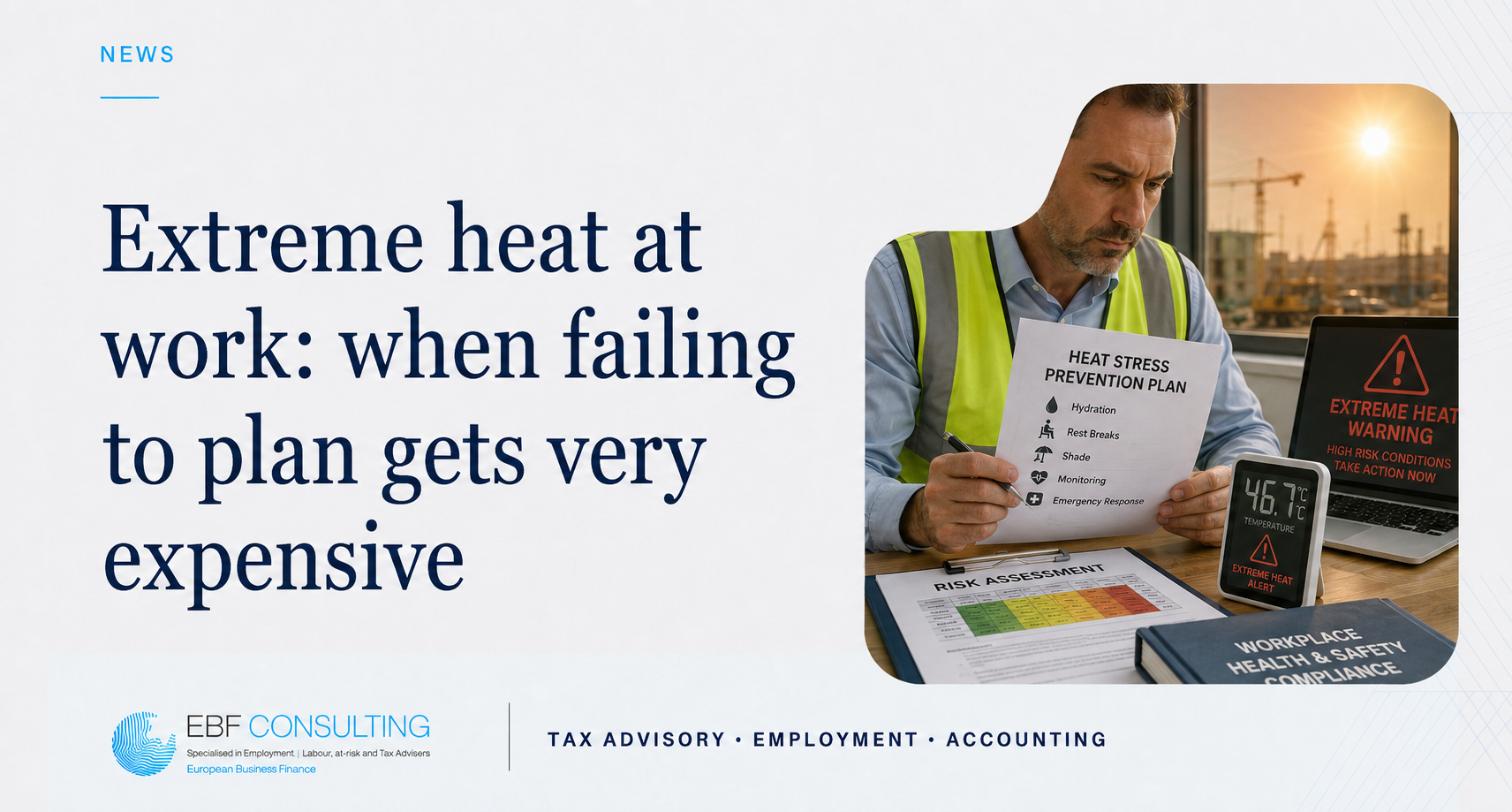
August has closed once again with temperatures that a decade ago we treated as exceptional and now simply expect. In parallel, the courts are setting an increasingly sharp standard for what is expected of an employer whose teams work outdoors. A ruling circulating this week illustrates it in the starkest possible terms.
A case that forces a review of your risk assessment
A street-cleaning worker died of heatstroke while working in temperatures above 36 °C. The ruling finds the employer liable, grounding that finding in a breach of occupational health and safety obligations: the company failed to specify or apply any measures for a shift worked alone, on the street, at those temperatures, with a risk of heatstroke that — in the ruling’s own words — had been clearly announced.
That last detail is the one to underline. This was not an unforeseeable accident. The risk was announced: weather warnings existed, the exposure was known, and the working arrangement — one person, alone, in a public street — magnified the severity of any incident.
The problem wasn’t the heat. It was the absence of measures
Here is the practical reading for any company with outdoor operations, and equally for those with warehouses, kitchens, unconditioned storage or delivery vehicles. Liability does not arise because it was hot — nobody controls that. It arises from failing to translate a foreseeable risk into concrete, applied measures.
“Concrete and applied” are the operative words. A risk assessment that mentions thermal stress in one generic paragraph does not discharge that duty. What is expected is far more operational: temperature thresholds that trigger defined measures, rescheduling to avoid peak hours, hydration and shaded-rest protocols, and — critically — procedures for lone working, including regular check-ins and a clear way to raise the alarm.
How to translate this into your prevention plan
If your people work exposed to heat, three questions need answering before the next high-temperature episode. One: does your risk assessment identify thermal stress with concrete thresholds, or does it merely name it? Two: is there a written procedure setting out what happens once that threshold is crossed, and is someone responsible for triggering it? Three: is anyone working alone, and if so, how is their situation monitored during the shift?
If any of those answers is uncertain, that’s your autumn project. September is a good moment: there is room to review the documentation, train line managers and have the procedure ready well before next summer.
Closing
Occupational risk prevention is judged by what was done, not by what was written. In a climate where heatwaves are structural rather than exceptional, having thermal stress properly resolved in your prevention plan has stopped being a nice-to-have and become a baseline expectation. If you’d like to review where your company stands, EBF can support you through the diagnosis and bring the documentation up to date. Let’s talk.